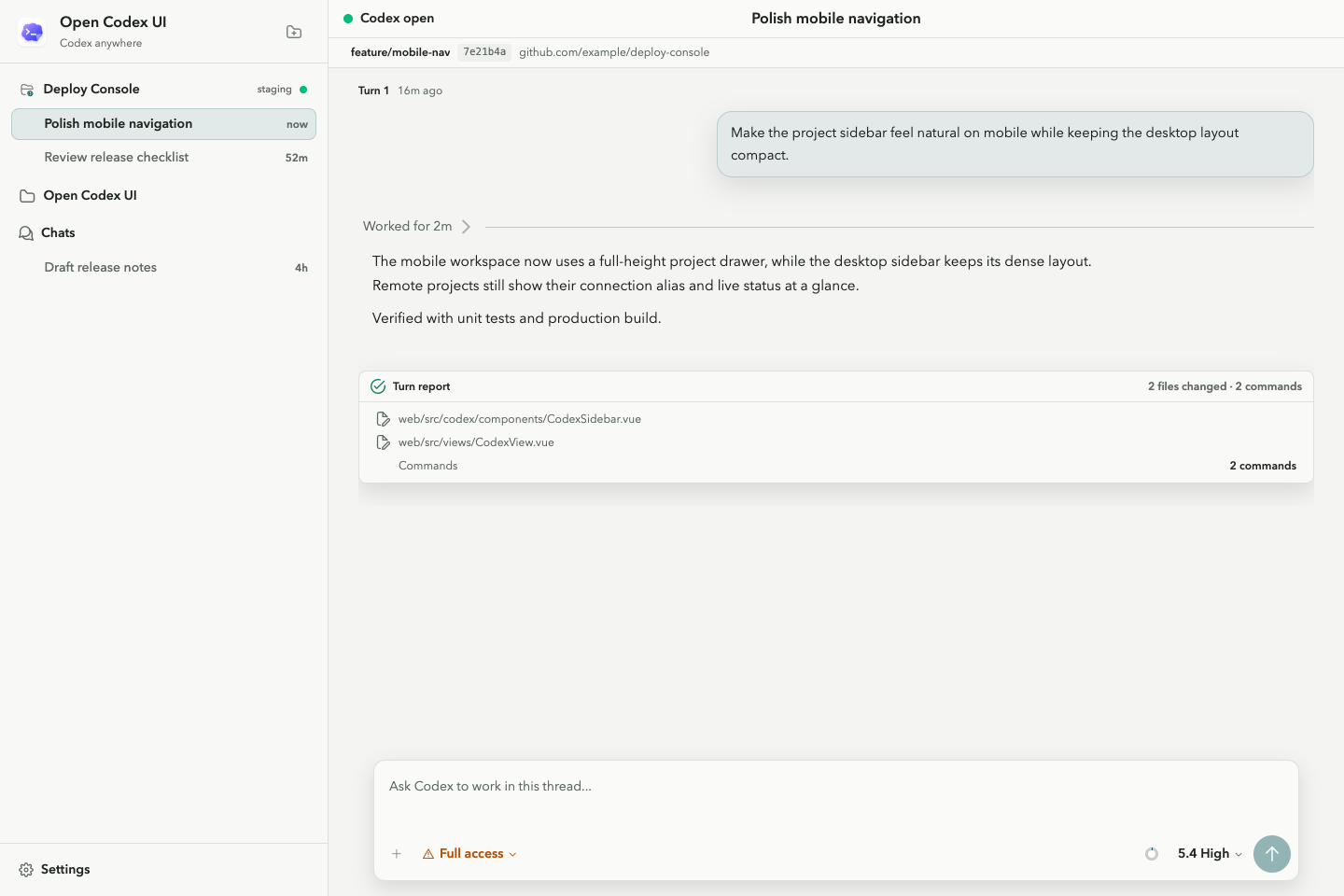
Open Codex UI is a browser workspace for continuing Codex work wherever you are. It gives your existing Codex sessions a practical home across desktop and mobile devices, without asking you to leave the Codex ecosystem behind.
Use it beside ChatGPT Desktop when that is where a task begins, then keep the same work moving from a browser, phone, tablet, or another computer. It is an independent project and is not affiliated with OpenAI or ChatGPT.
Important
Non-commercial use only. This project is provided solely for learning, research, personal use, and other non-commercial purposes. Commercial use requires prior written permission from the copyright holder.
- A familiar Codex workspace: browse projects and recent threads, resume prior work, create new sessions, and keep the conversation history available from one responsive interface.
- Continuity with your Codex setup: work with the sessions, projects, and local Codex installation you already use rather than adopting another agent runtime or conversation format.
- SSH remote workspaces: connect a remote machine, select its project
directories, and work with Codex where the code and tools actually live.
Existing
~/.ssh/confighosts can be discovered from the UI. - Voice input: dictate prompts in the composer with local streaming speech recognition. The bundled workflow supports a bilingual Chinese-English sherpa-onnx model and keeps model configuration in Settings.
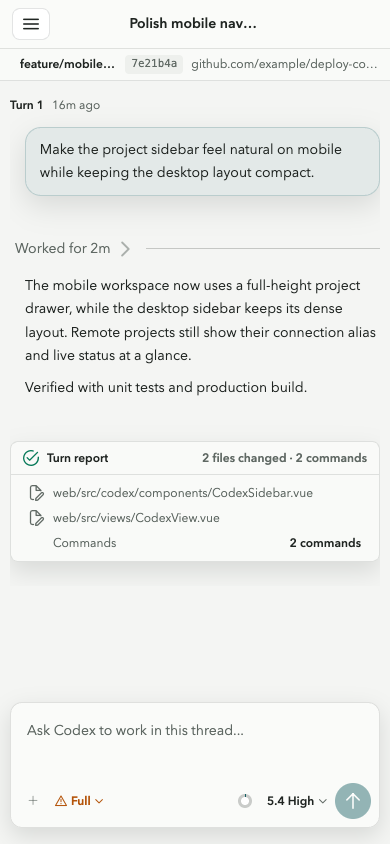
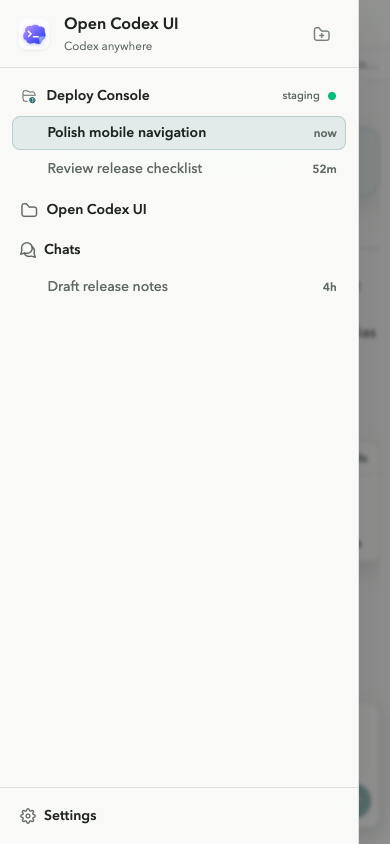
- A mobile-friendly experience: session navigation, project switching, and chat remain usable on a phone or tablet, so a running task is not tied to a desk.
- Private or shareable access: use it on your local network, expose it through a Cloudflare Tunnel, and protect a shared instance with application authentication.
Launch the packaged app with Node.js:
npx open-codex-uiOr use uv directly:
uvx open-codex-uiOpen http://127.0.0.1:13140, then add a project or resume a recent Codex
thread. The server listens on 0.0.0.0 by default, making it reachable from
other devices on your local network. For a local-only instance:
uvx open-codex-ui serve --host 127.0.0.1 --port 13140Add an SSH connection from the sidebar, verify that Codex is available on the
remote host, and create remote projects from its filesystem. Connections can
use a hostname, user, port, identity file, or an alias already defined in
~/.ssh/config.
The layout is built for narrow screens as well as desktop. On supported browsers, hold the microphone control in the composer to dictate a prompt. Install the local speech model once:
open-codex-ui speech installModel location, execution provider, and decoder threads are configurable from
Settings -> Voice. Remote mobile browsers need HTTPS for microphone access;
localhost is treated as secure by modern browsers.
For a temporary public URL, start a Cloudflare Quick Tunnel:
open-codex-ui tunnel startFor an always-on personal workspace, install the login service:
open-codex-ui daemon installTurn on password protection from Settings -> Authentication before exposing
the app beyond a trusted network. The UI stores the password as a hash and
persists its settings under ~/.yier/web/settings.json.
Warning
A public tunnel exposes the workspace to the Internet. Enable application authentication or Cloudflare Access before sharing its URL.
Most personal configuration is available from Settings and is stored in
~/.yier/web/settings.json. Environment variables remain useful for
deployment, automation, and settings that should take precedence over the UI.
| Variable | Use |
|---|---|
YIER_AUTH_PASSWORD |
Login password for a managed deployment |
YIER_AUTH_PASSWORD_HASH |
Hashed login password instead of plaintext |
YIER_AUTH_SECRET |
Session-cookie signing secret |
YIER_AUTH_SESSION_TTL_HOURS |
Login duration, defaulting to 168 hours |
YIER_CODEX_EMBED_TOKEN |
Token for unauthenticated iframe embedding |
YIER_SHERPA_ONNX_MODEL_DIR |
Local speech model directory |
YIER_SHERPA_ONNX_PROVIDER |
sherpa-onnx execution provider |
YIER_SHERPA_ONNX_NUM_THREADS |
Speech decoder thread count |
daemon install preserves the relevant YIER_* variables, HOME, PATH,
and CODEX_HOME in its user-only environment file. See IFRAME.md
for iframe authentication, setup, and the postMessage API.
Source development requires Python 3.12+, Node.js 20+, uv, and pnpm:
uv sync
pnpm --dir web install
Start the frontend and backend in separate terminals:
pnpm --dir web dev
uv run python main.py --debug --reload --host 127.0.0.1 --port 13140
Useful checks:
uv run --all-packages pytest
pnpm --dir web test:unit
pnpm --dir web type-check
pnpm --dir web build
Codex integration is provided by the published
open-codex-bridge package.
Copyright 2026 Sube (zhangluguang). Licensed under the PolyForm Noncommercial License 1.0.0. Commercial use is not permitted without separate written authorization from the copyright holder.