Observability for speculative decoding.
Sample sequences and inspect draft models.
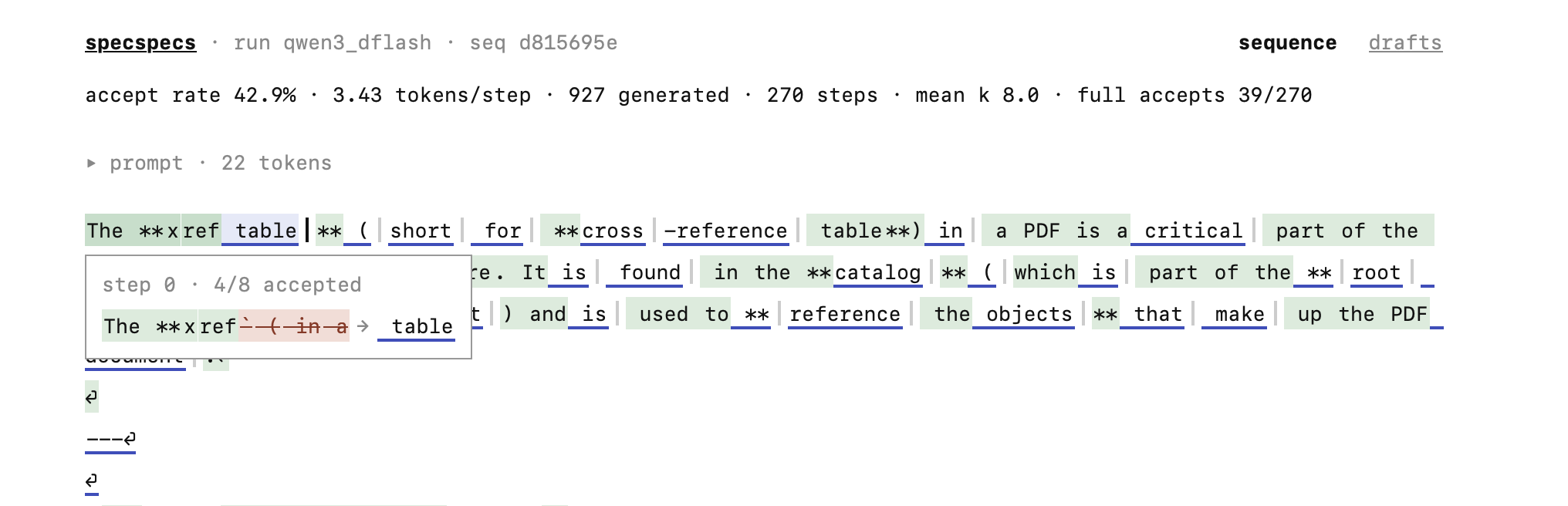
View the accept/reject statistics for your draft model, and actually see the drafts. In my opinion this will give you really strong intuition for how good the model is.
pip install specspecs --all-extras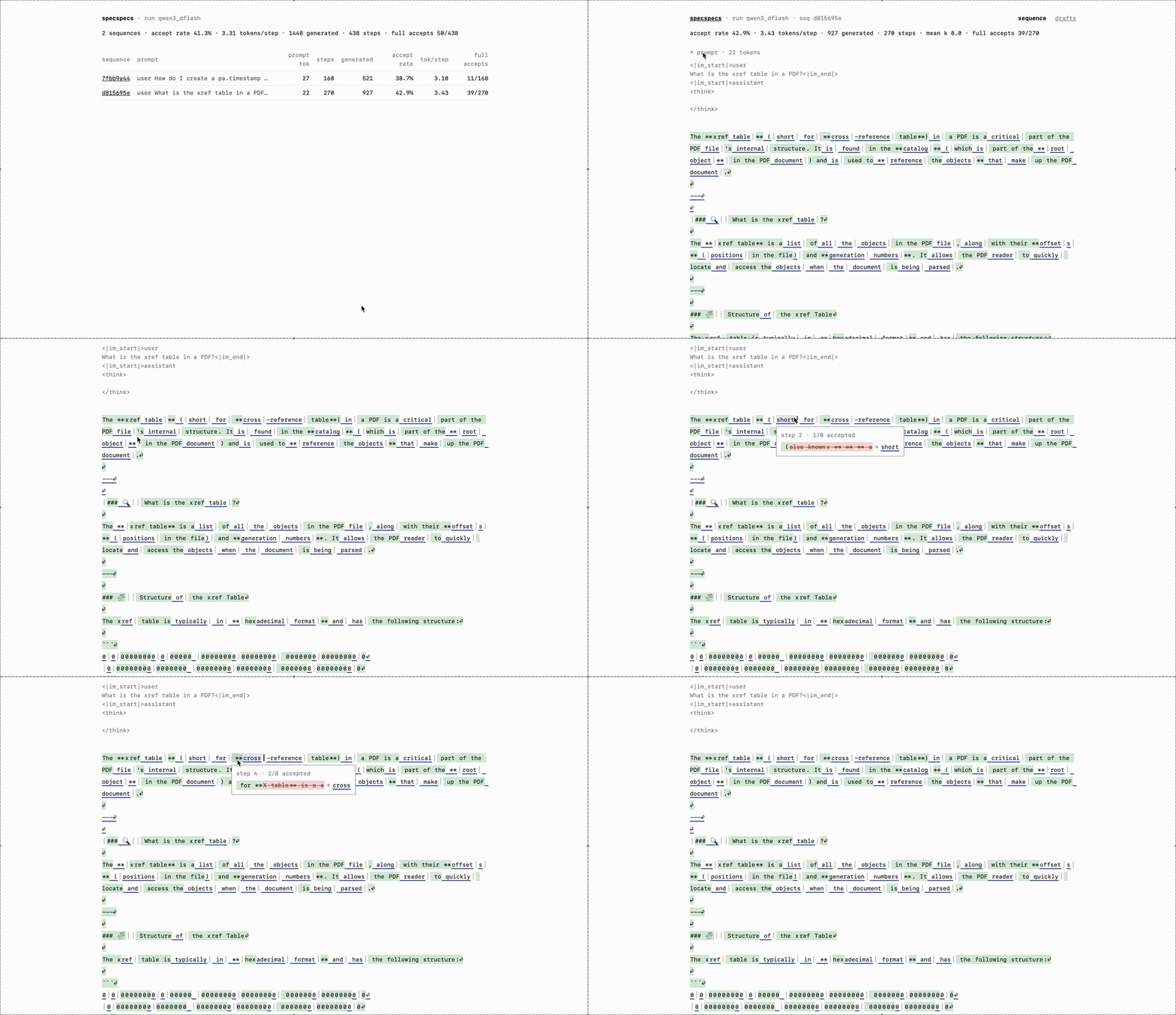
As of v0.2, specspecs ships with a vllm plugin!
For vLLM, usage is very simple:
- set a
SPECSPECS_DIRandSPECSPECS_RUN_IDenv var - run vLLM with
--no-async-scheduling
For example, to serve Qwen3-4B with a dFlash head:
export SPECSPECS_DIR="./logs" SPECSPECS_RUN_ID="dflash-qwen-4b"
vllm serve Qwen/Qwen3-4B \
    --speculative-config '{"method": "dflash", "model": "z-lab/Qwen3-4B-DFlash-b16", "num_speculative_tokens": 8}' \
    --no-async-scheduling
If instead you want to instrument a custom generate loop, start by checking out examples/qwen3_dflash.py.
You can run it with:
python examples/qwen3_dflash.py "What is speculative decoding?"
Which will populate ./logs with an observed sequence and all its drafts.
To start the server:
specspecs-serve
This will default to monitoring ./logs as the parquet directory.
There are two calls you instrument your generation loop with: register_sequence (once at the beginning of each sequence) and update_sequence (once for each draft).
import specspecs

spec_logger = specspecs.SpecLogger("logs/", "Run Name", tokenizer)
tokenizer may be a tokenizer or a model id; its name is stored on every
sequence so the viewer can decode the tokens. To log sequences from more than
one model, override it per sequence:
spec_logger.register_sequence(prompt_token_ids, sequence_id, tokenizer)Register Sequence:
spec_logger.register_sequence(prompt_token_ids, sequence_id)If you don't pass a sequence_id it creates one and returns it.
Update Sequence:
Pass all of the relevant per-draft info here.
spec_logger.update_sequence(sequence_id, draft_tokens, acceptance_length, emitted_token, k, step)It writes sequences and drafts to parquet files, then analyzes them with DuckDB.
I'm working on turning it into a vLLM plugin, and moving the parquet writer to a separate thread. This should be enough to run it on production serving infra (sampling traffic, worst case).