



A secure, high-performance, and human-friendly ID generator for Rust.
- Secure Uses the platform CSPRNG with unbiased sampling and no weak fallback. Generate independently across threads, processes, and cluster nodes; enforce absolute uniqueness with a database constraint.
- High-performance Optimized for fast, low-overhead ID generation and efficient scaling across concurrent workloads.
- Human-friendly Creates letter-first, lowercase-alphanumeric IDs by default with a fixed
LLDrhythm—no accidental long words, punctuation, or ambiguous characters. Easy to read, type, and transcribe; ready for URLs, filenames, database/cache/object-storage keys, DOM/CSS IDs, command lines, logs, and more.
use tidyid::tidyid;

let id1 = tidyid(32, false)?; // jh4yp2fm6rq6hj4fe6xh9aq8ar5ax3ng (length = 32)
let id2 = tidyid(16, false)?; // ce6qy8gc9nd7uu8r                 (length = 16)
let id3 = tidyid(10, false)?; // yj7tf9xw2r                       (length = 10)
let id4 = tidyid(10, true)?; // bQ3pB7gG5C (length = 10, allow_uppercase = true)cargo add tidyidor add it to Cargo.toml:
[dependencies]
tidyid = "2.1.1"
Enable the metrics feature to use the capacity and entropy helpers:
[dependencies]
tidyid = { version = "2.1.1", features = ["metrics"] }Install the command-line binary:
cargo install tidyidGenerate IDs:
tidyid
# dz6ut2ff4fq3vx2br2kw9qd3tg4xb9hn (length = 32)

tidyid -s 16
# gj3gp4kp7uv4tb2k (length = 16)

tidyid -s 10 -u
# Wx7pQ9jA2F (length = 10, allow_uppercase = true)
Use --size or -s to set the length. Use --allow-uppercase or -u
to allow uppercase letters.
By default, IDs repeat two lowercase letters followed by one digit (LLD):
xr3 fc9 xy2
| Characters | Positions | Alphabet |
|---|---|---|
| Letters | First two of each group | abcdefghjkmnpqrtuvwxyz |
| Digits | Every third character | 23456789 |
- Every ID starts with a letter.
i,l,o,s,0, and1are excluded to reduce visual and handwritten ambiguity.- The pattern prevents long letter sequences and needs no escaping in URL paths, filenames, or HTML/CSS IDs.
- In default mode, typing needs no Shift key,
_,-, or other punctuation.
Set allow_uppercase to true to sample letter positions from the combined
uppercase and lowercase alphabet.
| API | Description |
|---|---|
tidyid(length, allow_uppercase) |
Generate a 3–256 character ID. |
is_valid_id(value, length, allow_uppercase) |
Check format and an optional exact length. |
ensure_valid_id(value, length, allow_uppercase) |
Return InvalidIdLengthError or InvalidIdFormatError through ValidationError. |
get_id_capacity(length, allow_uppercase) |
Return the exact ID space as BigUint (metrics feature). |
get_id_entropy(length, allow_uppercase) |
Return entropy in bits (metrics feature). |
These functions are thread-safe.
Constants: LETTERS, LETTERS_WITH_UPPERCASE, DIGITS, DEFAULT_LENGTH, MIN_LENGTH, MAX_LENGTH.
Errors: InvalidIdLengthError, InvalidIdFormatError, GenerateError, ValidationError.
cargo bench --bench throughput measures complete public tidyid calls,
including secure random sampling and String allocation.
-
Unpredictability Native targets use the operating system CSPRNG through
getrandom. Browser-orientedwasm32-unknown-unknownbuilds use Web Crypto when thewasm_jsfeature is enabled. TidyID never uses a predictable PRNG. -
Uniformity Letter positions use rejection sampling, while digit positions use an exact eight-way mapping. Both avoid modulo bias, so every valid ID of the same length and mode has equal probability.
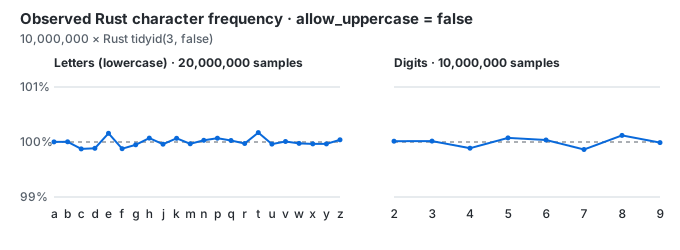
Default mode (
allow_uppercase = false): observed frequencies from 10,000,000 generated 3-character IDs stay close to their expected uniform distribution.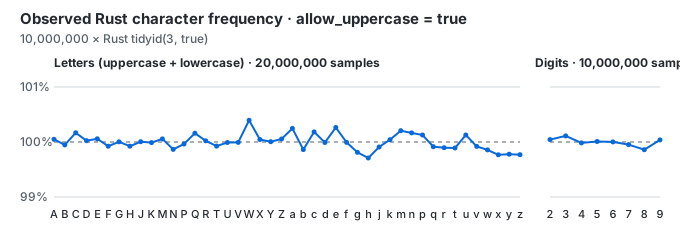
Uppercase-enabled mode (
allow_uppercase = true): observed letter and digit frequencies from 10,000,000 generated 3-character IDs stay close to their expected uniform distribution. -
Collision-aware Choose a length for your scale to make collisions extremely unlikely. Use a database
PRIMARY KEYorUNIQUEconstraint when absolute uniqueness must be enforced.
Default mode (
allow_uppercase = false)
Length Capacity Entropy 8 7,256,313,856 32.76 bits 10 1,277,111,238,656 40.22 bits 12 224,771,578,003,456 47.68 bits 16 19,146,942,100,646,395,904 64.05 bits 23 6,315,282,784,770,463,143,393,492,992 92.35 bits 32 366,605,391,805,505,419,895,548,144,464,707,977,216 128.11 bits
Uppercase allowed (
allow_uppercase = true)
Length Capacity Entropy 8 464,404,086,784 38.76 bits 10 163,470,238,547,968 47.22 bits 12 57,541,523,968,884,736 55.68 bits 16 39,212,937,422,123,818,811,392 75.05 bits 23 413,878,372,582,717,072,565,435,956,723,712 108.35 bits 32 1,537,654,461,271,398,604,689,577,164,520,902,527,668,977,664 150.11 bits
Use 16 or more characters for large public datasets. For security tokens, choose the length based on your threat model. A 32-character TidyID provides 128.11 bits of entropy by default, or 150.11 bits with allow_uppercase = true.
Use a primary key or unique constraint. Insert first and retry only an ID conflict—never query before inserting:
use sqlx::PgPool;
use tidyid::tidyid;

async fn create_resource(pool: &PgPool) -> Result<String, Box<dyn std::error::Error>> {
    for _ in 0..128 {
        let id = tidyid(16, false)?;
        let inserted = sqlx::query_scalar::<_, String>(
            r#"INSERT INTO resources (id) VALUES ($1)
               ON CONFLICT (id) DO NOTHING RETURNING id"#,
        )
        .bind(&id)
        .fetch_optional(pool)
        .await?;

        if inserted.is_some() {
            return Ok(id);
        }
    }
    Err("unable to insert a resource with a unique TidyID".into())
}
Propagate network, permission, transaction, and non-ID constraint errors.
-
Rust
1.85or newer -
A target supported by
getrandom -
For browser-oriented
wasm32-unknown-unknown, enablewasm_js:[dependencies] tidyid = { version = "2.1.1", features = ["wasm_js"] }
cargo fmt --all -- --check
cargo clippy --all-targets --all-features -- -D warnings
cargo test --all-features
cargo bench
cargo run --release --features metrics --example generate_readme_dataMIT