Secure, no_std-first Base64 for Rust.
Strict RFC 4648 codecs, caller-owned buffers, optional SIMD, and zero core dependencies.
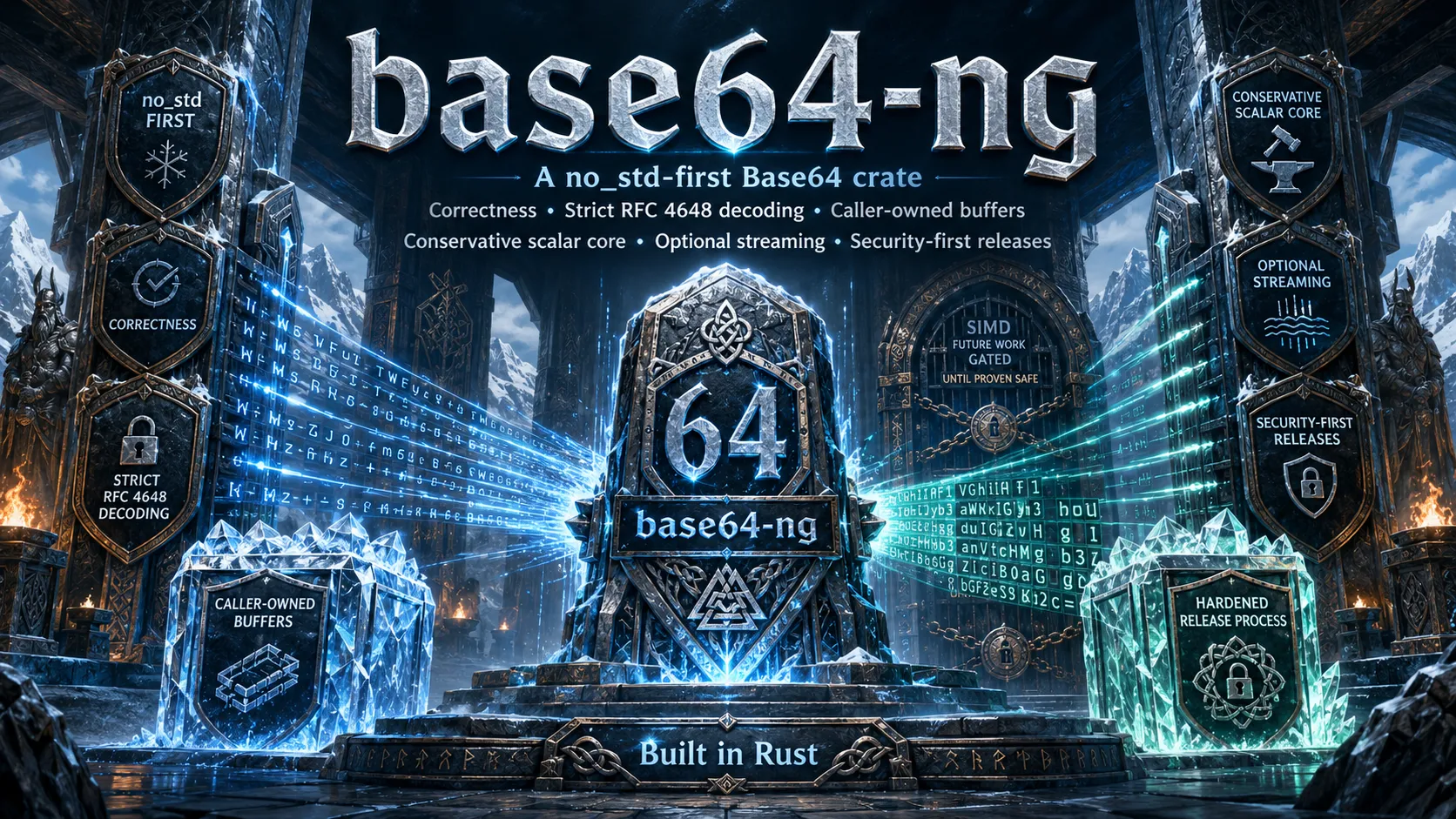
base64-ng provides strict RFC 4648 Base64, no_std operation, caller-owned
and allocating APIs, incremental and in-place transforms, optional admitted
SIMD backends, and separately named compatibility policies.
Zero external runtime or development dependencies in Cargo.toml.
This source tree defines the synchronized 2.0.1 package family. This patch
reduces published package and README size. Runtime behavior
and the public 2.0 API remain unchanged from 2.0.0; repository-only release
scripts, evidence, API snapshots, and engineering ledgers remain available on
GitHub instead of being copied into the crates.io archive.
[dependencies]
base64-ng = "2.0.1"
For ordinary Standard Base64 with canonical padding:
let encoded = base64_ng::encode(b"hello").unwrap();
assert_eq!(encoded, "aGVsbG8=");

let decoded = base64_ng::decode(encoded.as_bytes()).unwrap();
assert_eq!(decoded, b"hello");
Use an explicit preset when the alphabet and padding policy should be visible:
use base64_ng::STRICT_URL_SAFE_UNPADDED;

let encoded = STRICT_URL_SAFE_UNPADDED
    .encode_to_string(b"hello")
    .unwrap();
assert_eq!(encoded, "aGVsbG8");
assert_eq!(
    STRICT_URL_SAFE_UNPADDED.decode_to_vec(encoded.as_bytes()).unwrap(),
    b"hello"
);
The strict presets are:
STRICT_STANDARD_PADDEDSTRICT_STANDARD_UNPADDEDSTRICT_URL_SAFE_PADDEDSTRICT_URL_SAFE_UNPADDED
Strict decoders reject whitespace, mixed alphabets, impossible lengths, malformed padding, trailing data after padding, and non-canonical unused bits. WHATWG-forgiving, legacy-whitespace, wrapped, MIME, PEM, and other protocol behavior is available only through explicitly named APIs or companion crates.
| Need | API |
|---|---|
| Ordinary owned Standard Base64 | encode and decode |
| Explicit alphabet and padding | A STRICT_* preset |
| Transactional caller-owned output | encode_into and decode_into |
| Heapless incremental processing | encoder() and decoder() |
| In-place transformation | encode_in_place and decode_in_place |
| Policy-carrying encoded text | Base64String<S> |
| Compile-time fixed data | encode_array and decode_array |
| Fixed-capacity runtime output | encode_bounded and decode_bounded |
| Secret-bearing frames | secret::{SecretArrayFrame, SecretVecFrame} |
| Synchronous I/O | Enable stream |
| Async I/O | base64-ng-tokio |
| Serde fields | base64-ng-serde |
base64_ng::prelude contains the focused ordinary API imports. It deliberately
does not import secret, compatibility, protocol, or historical surfaces.
One-shot *_into operations are transactional: an error leaves the complete
destination unchanged.
use base64_ng::STRICT_STANDARD_PADDED;

let mut encoded = [0u8; 8];
let encoded_len = STRICT_STANDARD_PADDED
    .encode_into(b"hello", &mut encoded)
    .unwrap();
assert_eq!(&encoded[..encoded_len], b"aGVsbG8=");

let mut decoded = [0u8; 5];
let decoded_len = STRICT_STANDARD_PADDED
    .decode_into(&encoded[..encoded_len], &mut decoded)
    .unwrap();
assert_eq!(&decoded[..decoded_len], b"hello");
For in-place encoding, reserve the encoded capacity first:
use base64_ng::STRICT_STANDARD_PADDED;

let mut buffer = [0u8; 8];
buffer[..5].copy_from_slice(b"hello");
let written = STRICT_STANDARD_PADDED
    .encode_in_place(&mut buffer, 5)
    .unwrap();
assert_eq!(&buffer[..written], b"aGVsbG8=");
Incremental states retain at most partial Base64 quanta and report exact input
and output progress. Call finish to validate or emit the final tail.
use base64_ng::{Status, STRICT_STANDARD_PADDED};

let mut encoder = STRICT_STANDARD_PADDED.encoder();
let mut output = [0u8; 8];
let step = encoder.update(b"hello", &mut output).unwrap();
let mut written = step.progress().output_produced();
let final_step = encoder.finish(&mut output[written..]).unwrap();
written += final_step.progress().output_produced();

assert_eq!(final_step.status(), Status::Complete);
assert_eq!(&output[..written], b"aGVsbG8=");
The decoder uses the same lifecycle and progress contract. See the incremental encoder and decoder finalization guides for fragmented-input examples.
Base64String<S> stores validated ordinary Base64 together with its exact
codec policy:
use base64_ng::{Base64String, STRICT_STANDARD_PADDED};

let stored = Base64String::encode(STRICT_STANDARD_PADDED, b"hello").unwrap();
assert_eq!(stored.as_str(), "aGVsbG8=");
assert_eq!(stored.decode().unwrap(), b"hello");
It is printable and non-wiping; it is not a secret container. Allocation-free
display, rollback-safe encode_append, and encoded_chunks are available
from the same strict presets.
Validate without producing decoded output:
use base64_ng::{STRICT_STANDARD_PADDED, STRICT_URL_SAFE_UNPADDED};

STRICT_STANDARD_PADDED.validate(b"aGVsbG8=").unwrap();
assert!(STRICT_STANDARD_PADDED.validate(b"aGVsbG8").is_err());
STRICT_URL_SAFE_UNPADDED.validate(b"-_8").unwrap();
Exact WHATWG forgiving decode is separate from strict RFC 4648:
use base64_ng::{web, STRICT_STANDARD_PADDED};

assert_eq!(web::FORGIVING.decode_to_vec(" Z h = = ").unwrap(), b"f");
assert!(STRICT_STANDARD_PADDED.decode_to_vec(b" Z h = = ").is_err());
Legacy ASCII-whitespace decode is also explicit:
use base64_ng::{legacy, STRICT_STANDARD_PADDED};

let mut output = [0u8; 5];
let written = legacy::ASCII_WHITESPACE
    .decode_into(&STRICT_STANDARD_PADDED, b" aG\r\nVs\tbG8= ", &mut output)
    .unwrap();
assert_eq!(&output[..written], b"hello");
Forgiving and legacy policies are ordinary-data APIs and are unavailable to secret frames.
| Feature | Default | Purpose |
|---|---|---|
alloc |
yes | Vec, String, and owned convenience APIs |
std |
yes | Standard error and runtime support |
simd |
no | Admitted Standard/URL-safe encode and strict-decode acceleration |
stream |
no | Synchronous std::io adapters |
secrets |
no | Bounded secret storage, fixed-work transforms, and explicit exposure |
checked-backend |
no | SIMD plus bounded scalar verification, quarantine, and scalar retry |
allow-wasm32-best-effort-wipe |
no | Acknowledge wasm cleanup limitations for secrets builds |
allow-compiler-fence-only-wipe |
no | Acknowledge unsupported-native cleanup limitations |
tokio |
no | Reserved, currently inert and dependency-free; use base64-ng-tokio |
kani |
no | Reserved verifier integration |
fuzzing |
no | Reserved fuzz integration |
Disable defaults for core-only embedded use:
[dependencies]
base64-ng = { version = "2.0.1", default-features = false }
Enable ordinary SIMD dispatch without changing the public codec API:
[dependencies]
base64-ng = { version = "2.0.1", features = ["simd"] }
Scalar by default; std x86/x86_64 encode selects SSSE3/SSE4.1, AVX2, or AVX-512 VBMI by length, strict decode selects SSSE3/SSE4.1 or AVX2. Admitted
little-endian AArch64 NEON, wasm simd128, and exact-profile Linux/SpacemiT
X60 RVV paths are selected only inside their documented scopes. Unsupported
CPUs, custom alphabets, compatibility policies, and secret operations retain
scalar behavior.
Runtime selection can be inspected with runtime::backend_report().
Ordinary strict decoding returns detailed errors and may exit early. For keys,
tokens, passwords, or other secret-bearing frames, enable secrets and use the
bounded fixed-work API:
[dependencies]
base64-ng = { version = "2.0.1", default-features = false, features = ["secrets"] }
use base64_ng::{secret::{SecretArrayFrame, SecretInput}, STRICT_STANDARD_PADDED};
let mut frame = SecretArrayFrame::<5>::new(&STRICT_STANDARD_PADDED).unwrap();
frame.update(&SecretInput::new(b"aGVsbG8=")).unwrap();
let secret = frame.finish().unwrap();
assert_eq!(secret.expose_secret().as_bytes(), b"hello");This is a constant-time-oriented scalar boundary with bounded private staging, opaque validity results, and best-effort cleanup. It has project timing, assembly, Kani, Miri, and test evidence, but no formal cryptographic guarantee. It must not be documented as a formally verified cryptographic constant-time API. Protected-memory claims additionally require an admitted provider and runtime assurance token. Read the secret decoding and assurance guides before deployment.
Optional ecosystem and protocol dependencies remain outside the zero-dependency core.
| Package | Purpose |
|---|---|
base64-ng-sanitization |
Protected and locked secret integration |
base64-ng-derive |
Base64Secret derive for fixed secret newtypes |
base64-ng-serde |
Explicit Serde field adapters |
base64-ng-bytes |
Bytes, Buf, and BufMut helpers |
base64-ng-subtle |
Sealed subtle::ConstantTimeEq integration |
base64-ng-tokio |
Async helpers and streaming adapters |
base64-ng-imap |
RFC 3501 modified-Base64 payload transforms |
base64-ng-mime |
RFC 2045 Base64 body transforms |
base64-ng-multibase |
Registered Base64-family multibase prefixes |
base64-ng-password |
Passlib PBKDF2 and SHA-crypt field transforms |
base64-ng-openpgp |
RFC 9580 ASCII armor |
base64-ng-pem |
RFC 7468 textual encoding |
@valkyoth/base64-ng-wasm-loader |
Scalar/simd128 JavaScript loader |
Each Rust companion has its own crate README and examples. The package topology defines their boundaries.
Install the supported JavaScript loader with:
npm install @valkyoth/base64-ng-wasm-loaderimport { Codecs, createBase64Ng } from "@valkyoth/base64-ng-wasm-loader";
const base64 = await createBase64Ng();
const encoded = base64.encode(new TextEncoder().encode("hello"), Codecs.URL_SAFE_NO_PAD);
const decoded = base64.decode(encoded, Codecs.URL_SAFE_NO_PAD);
base64.dispose();"Project validated" means the named repository tests and evidence gates passed on the stated systems. It does not mean certification, independent review, whole-crate formal proof, or a portable performance guarantee.
| Backend | Project evidence | Dispatch status |
|---|---|---|
| Portable scalar | Native x86-64, AArch64, RISC-V; QEMU big-endian targets | Admitted |
| x86 SSSE3/SSE4.1, AVX2, AVX-512 VBMI | Native differential, kernel, assembly, and benchmark evidence | Admitted within documented thresholds |
| AArch64 NEON | Apple Silicon and AWS Neoverse-N1 evidence | Admitted |
wasm simd128 |
Node, Wasmtime, Chromium, Firefox, and Safari evidence | Admitted artifact |
| RISC-V RVV 1.0 | Native SpacemiT X60 plus QEMU vector-length evidence | Admitted only for the exact documented X60 profile |
| AArch64 SVE | QEMU and assembly evidence only | Not admitted |
| Big-endian SIMD | No accelerated backend | Scalar only |
| Secret encode/decode | Scalar fixed-work evidence | Separate from ordinary SIMD |
The full backend matrix, exact machines, thresholds, non-claims, and evidence links live in the Trust Dashboard and dispatch matrix.
MSRV remains Rust 1.90.0. The active release toolchain is Rust 1.97.1.
| Rust | Evidence |
|---|---|
1.90.0 |
MSRV compatibility check |
1.91.0 - 1.97.0 |
cargo check --all-features |
1.97.1 |
Active release toolchain and full release checks |
New deployments should prefer the latest tested stable Rust.
- Migration guide
- Codec and operation contracts
- Constant-time posture
- Unsafe boundary
- Trust Dashboard
- Security controls
- 2.0 commit plan
- Governance decision
- Release evidence
Repository CI includes formatting, Clippy, tests, rustdoc, dependency policy, fuzz and formal-verification harnesses, hardware-specific execution, SBOM, and reproducible build check. These engineering artifacts remain in the GitHub repository and are intentionally excluded from the crates.io package.
Licensed under either Apache-2.0 or MIT, at your option.
Contributions and release policy are documented in CONTRIBUTING.md and docs/RELEASE.md.